
Your CRM Loss Data Is Not the Truth. Here Is What to Do About It.
Make it stand out
Whatever it is, the way you tell your story online can make all the difference.
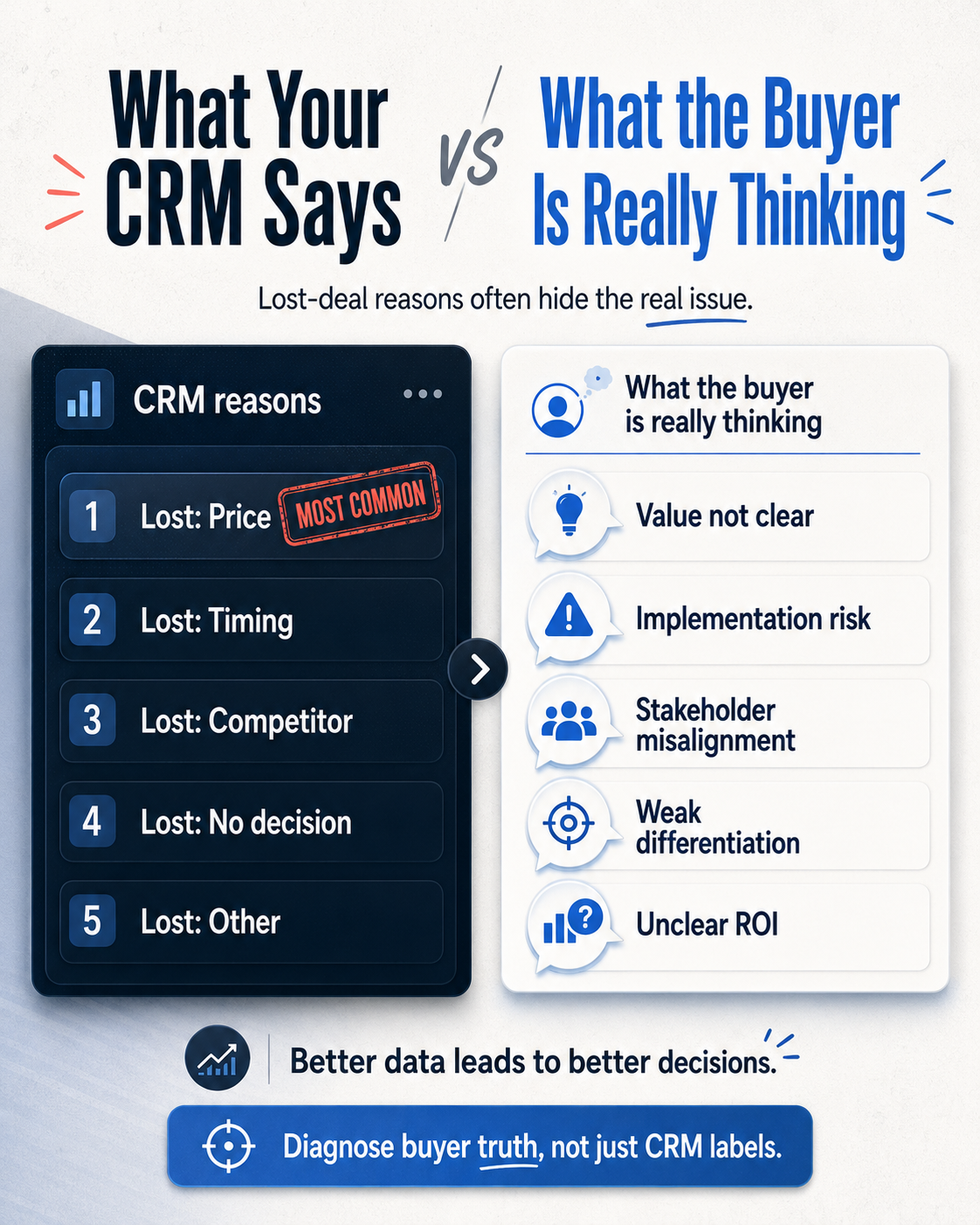
In most B2B commercial organisations, closed-lost data is treated as a reliable signal. Leaders use it to refine pricing, reframe positioning, update battlecards, and direct sales enablement investment.
The problem: that data is largely constructed by people who had a personal interest in a particular version of events.
The gap between seller and buyer reality
Corporate Visions analysed over 100,000 B2B purchase decisions and found that sellers and buyers give conflicting reasons for the same deal outcome between 50% and 70% of the time.
The mechanism behind this gap is straightforward. When a rep records a loss, they face a choice between accuracy and comfort. "Lost to competitor" or "pricing too high" are safe selections. "I failed to reach the economic buyer" or "I lost control of the evaluation" are not options most reps will volunteer.
Buyers compound the problem. Rather than giving a frank assessment of why they did not proceed, most offer a polite exit. Budget constraints are easier to say than "we didn't trust the person selling to us."
The result is a dataset that reflects how people want to be perceived, not what actually happened.
What gets built on false signal
When loss data is distorted, the decisions built on top of it follow.
Pricing gets cut when the real issue was poor discovery. Competitive intelligence programmes chase the wrong rivals when the actual barrier was stakeholder paralysis. Enablement investment targets pitch skills when the gap was executive access.
Each of these decisions costs money and time. Worse, they move the organisation further from the actual constraint.
Diagnosis before prescription
The instinct when win rates drop is to act - retrain, reposition, discount. But action without an accurate diagnosis rarely corrects the underlying problem.
Before building a fix, leaders need an objective read of what is actually happening in their deals.
Paradym Shift's Deal RealitiScan cuts through the CRM narrative. It assesses live and closed opportunities across the dimensions that actually determine outcomes: customer connections, stakeholder influence, value co-creation, and execution discipline. The diagnostic surfaces what seller-reported data cannot, without relying on the same self-protective instincts that distort the CRM in the first place.
The RealitiScan is available at no fee. It is designed to give commercial leaders the evidence they need before committing to a course of action.
From evidence to execution
Identifying the true gap is only useful if something is done with it.
Where the RealitiScan reveals specific structural weaknesses - whether that is poor executive presence, weak discovery, or failure to manage the buying committee - Fresh Perspectives works with leadership teams to address those gaps directly. The work is targeted, not generic, because the diagnostic removes the guesswork.
The commercial cost of comfortable data
Every quarter that passes with distorted loss data in your CRM is a quarter where strategic decisions are made against the wrong evidence.
The fix is not a better CRM dropdown menu. It is an independent, objective view of what is actually happening in your commercial pipeline - and a clear line between that evidence and the action you take next.
If you want to know what your loss data is not telling you, start with the evidence. paradymshift.com
FAQ
Q: Why do sellers and buyers give different reasons for the same lost deal? Self-preservation shapes how reps record outcomes. Selecting "failed to articulate value" is an admission of personal failure. "Pricing too high" deflects responsibility. Buyers often reinforce this by offering polite exits - citing budget rather than trust or competence concerns. Corporate Visions research across 100,000+ B2B decisions found disagreement on loss reasons in 50% to 70% of cases.
Q: What is wrong with using CRM loss data to guide commercial strategy? CRM loss reasons reflect how people want to be perceived, not what actually happened. When strategy, pricing, and enablement are built on that data, they optimise against a distorted signal - cutting prices when the issue was discovery, or training pitch skills when the gap was stakeholder access.
Q: What is a Deal RealitiScan and how does it differ from CRM analysis? A Deal RealitiScan from Paradym Shift assesses live and closed opportunities against objective criteria across customer connections, stakeholder influence, value co-creation, and execution discipline. It surfaces structural deal weaknesses independent of seller-reported narrative. It is available at no fee for commercial leaders who want evidence before acting.
Q: How should B2B sales leaders act on win-loss diagnostic findings? Once the true gap is identified - whether that is executive access, discovery discipline, or buying committee management - action can be targeted rather than generic. Fresh Perspectives works with leadership teams to address specific capability and execution gaps identified through the diagnostic process.
Q: How common is it for B2B deals to be lost for reasons different from those recorded? Research from Corporate Visions suggests that in 50% to 70% of B2B deals, the reason recorded by the seller does not match the reason given by the buyer. This makes CRM-reported loss data an unreliable foundation for commercial decision-making without independent validation.
#WinLossAnalysis #B2BSales #SalesLeadership #CRMData #RevenueOperations #CommercialExcellence #SalesEffectiveness #GoToMarket #RevenueIntelligence #SalesDiagnostic